
On January 15th, we had the pleasure to host our clients for the yearly edition of the Cyrias Connect celebrating this year our 8th anniversary.
The hot topic we wanted to present to our audience with our customer is External Workforce Management with the Ivalua solution.
Groupe BPCE and Cyrias have successfully implemented a complex project to harmonize and automate these purchases at the group level.
It is a strategic topic as the importance of the global workforce management market was valued at approximately $9-10 billion in 2024, with projections to reach $22-31 billion by 2030-2035 and Europe held the largest workforce management market share at 33% according to 2024 Precedence Research, valued at approximately $3.5 billion. However, in contrast to these impressive figures and if we zoom in a more recent period the Artificial Intelligence (1) and the strengthening of regulatory compliance (2) are profoundly transforming the procurement of intellectual services. The market is experiencing a 7% contraction in purchasing volumes in the IT sector, primarily due to AI-enabled automation that reduces the need for external service providers.
Simultaneously, procurement departments are refocusing their priorities on regulatory compliance rather than costs: 39% now integrate CSRD directive requirements into their selection criteria, while 70% consider image and reputation risks as priorities. Legal risks dominate concerns, with 89% of buyers vigilant about economic dependence and 86% about the use of illegal labor supply. The gradual implementation of the European AI Act further reinforces these requirements, mandating transparency, traceability, and documentation with penalties that can reach several million euros, which pushes companies to prioritize rigorous supplier risk management (regular assessments at 71%, compliance reviews at 37%) over an approach purely focused on cost optimization.
The Rising Importance of External Workforce Management: Groupe BPCE and Cyrias
The modern enterprise workforce (and more specifically intellectual services) is fundamentally different from what it was a decade ago. According to recent studies, external workers (including contractors, consultants, freelancers, and statement-of-work (SOW) providers) now represent between 30% to 50% of the total workforce in large organizations, with this percentage continuing to grow across all sectors.
This shift is driven by multiple factors:
- Digital Transformation Acceleration: Organizations require specialized skills in areas like AI, cybersecurity, cloud computing, and data analytics—expertise that is often scarce and better sourced externally for specific projects rather than hired permanently.
- Flexibility and Agility: The ability to scale teams up or down based on project needs, market conditions, or seasonal demands has become a competitive advantage.
- Cost Optimization: While external workers often command higher hourly rates, their total cost of ownership can be lower when considering benefits, long-term commitments, and administrative overhead.
- Regulatory Complexity: Legislation around worker classification, co-employment risks, and social security obligations varies significantly across geographies, creating compliance challenges for multinational organizations.
However, this evolution brings significant challenges. Many organizations lack visibility into their external workforce spending, which can represent 10% to 40% of total workforce costs. Without proper systems and processes, companies face:
- Maverick spending and off-contract engagements
- Compliance risks related to worker misclassification and co-employment
- Supplier proliferation with hundreds or thousands of staffing agencies
- Lack of standardization in onboarding, performance management, and offboarding
- Data fragmentation across multiple systems and departments
- Limited strategic insights for workforce planning and optimization
The regulatory environment has also become increasingly complex, particularly in Europe. The EU Platform Work Directive, adopted in 2024, establishes new rules for platform workers and presumptions of employment status. In France, the Loi Travail and subsequent amendments have reinforced protections against illegal temporary work and strengthened obligations around equal treatment of temporary and permanent workers.
Financial services organizations, already subject to stringent regulatory oversight, face additional scrutiny around operational resilience, data protection (GDPR), and outsourcing arrangements. Regulatory bodies like the ACPR in France and the ECB at the European level have clear expectations regarding third-party risk management and governance of external workforce arrangements.
Groupe BPCE, Cyrias and Ivalua: zooming on the External Workforce Management
Groupe BPCE manages thousands of external workers supporting critical initiatives across retail banking, corporate and investment banking, asset management, and insurance operations. With operations across France and international markets, the complexity of managing external workforce compliance, cost optimization, and talent quality represented a significant challenge.
Both Cyrias and Ivalua count Groupe BPCE has a historical client with close collaboration track.
The Procurement Function ambition was to harmonise ways of working to create visibility, transparency, auditability. They innovated by creating one solution for all its entities to harmonise, standardise and streamline the procurement of external workforce.
They directed their effort to create robust processes that could be implemented in one Source To Contract solution for the entire group.
Of course the project phase from its original design to its final configuration and roll out was successful because of the close collaboration between Cyrias and Groupe BPCE teams.
The result is a fully automatised process that can be described as follow:
- Supplier Relationship Management module that ensures up to date Single Source of Truth for all the qualified supplier information.
- Contract Lifecycle Management module ensures the up to date signed contracts with templates validated by the Legal department and prices negotiated by the Procurement Department. The clauses in these contracts are dynamic and flow throughout the rest of the supplier engagement process. As a result, the supplier can only propose rates within the range negotiated in the master agreement, and payment of their invoices is subject to clauses on the quality of deliverables or tracking of workers’ time in Time and Materials.
- Sourcing module enables simple Request For Proposals so suppliers can quote within the price range previously defined in their frame agreement.
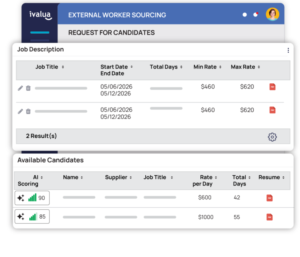
The process is completely seamless and takes only a few minutes: the consultation is sent to the supplier who submits in return the technical file and the daily rate for the profiles they wish to propose. The business user who needs this external expertise sees that AI proposes a matching score between the skills offered and those in the initial request. They also have access to suggested interview questions and can schedule interviews directly from the Ivalua application. All of this facilitates the work of internal clients who are not experts in candidate selection. The Buyer in charge of the RFP can send the contract which is signed with electronic signature. Then, the work order is sent. A dashboard and specific menus allow tracking of the entire process.
The core features and the benefits of the Ivalua External Workforce Management Solution:
Select Phase – Right Talent at Right Cost:
The platform enables business users to manage candidate selection within the framework of their external skills requests. The rates negotiated by Buyers with the established supplier panel are automatically proposed to them, ensuring automatic adherence to master agreements. AI helps internal clients select the skills best suited to meet their needs and schedule interviews with candidates.
Engage Phase – Swift & Risk-Free Onboarding:
The system accelerates the onboarding of external workers while ensuring compliance with company policies, internal regulations, and other IT charters, for example. All candidate proposals, interviews, and decisions are documented in the system, creating a tracking mechanism that enables analysis of the time required to find the right skills, the quality of proposed candidates, and supplier performance. It relies on AI to avoid duplicates, verify credentials, track assignment durations, and provide complete worker management with assignment history and performance tracking. The system also enables precise monitoring of external workers, their certifications, their history with the client, and the client tools they have access to, in order to meet the dual imperatives of legal compliance and contractual obligations.
Execute Phase – Budget, Planning & Quality Control:
Companies can monitor their budget in real time, control overtime through timesheets, track project progress, manage milestones, verify and validate the quality of deliverables for fixed-price contracts.
Key Benefits
One solution: A single solution: a platform that enables management of all spending with all suppliers, helping companies in particular to secure their service investment through precise cost tracking, deliverable quality monitoring, and accurate legal risk management. Comprehensive dashboards provide both a consolidated view for Buyers and operational details for internal clients. Indicators help better plan skills requirements, identify savings opportunities, and evaluate suppliers’ operational efficiency with their response times and the suitability of the profiles they propose, for example.
Conclusion
In an era where talent is the ultimate competitive advantage and workforce models continue to evolve, external workforce management has emerged from the shadows of tactical procurement to become a strategic imperative. Groupe BPCE’s implementation demonstrates that even in highly regulated industries with complex organizational structures, external workforce transformation is achievable with the right combination of technology, process design, governance, and change management.
The partnership between Cyrias’ expertise in procurement transformation and digital implementation, combined with Ivalua’s leading External Workforce Management technology, enables the deployment of a powerful platform for organizations ready to transform how they manage, optimize and leverage their external workforce as a strategic asset. The harmonisation of processes across all Groupe BPCE entities delivers visibility, transparency and auditability while ensuring compliance with the stringent regulatory requirements of the banking sector.


 Creation by